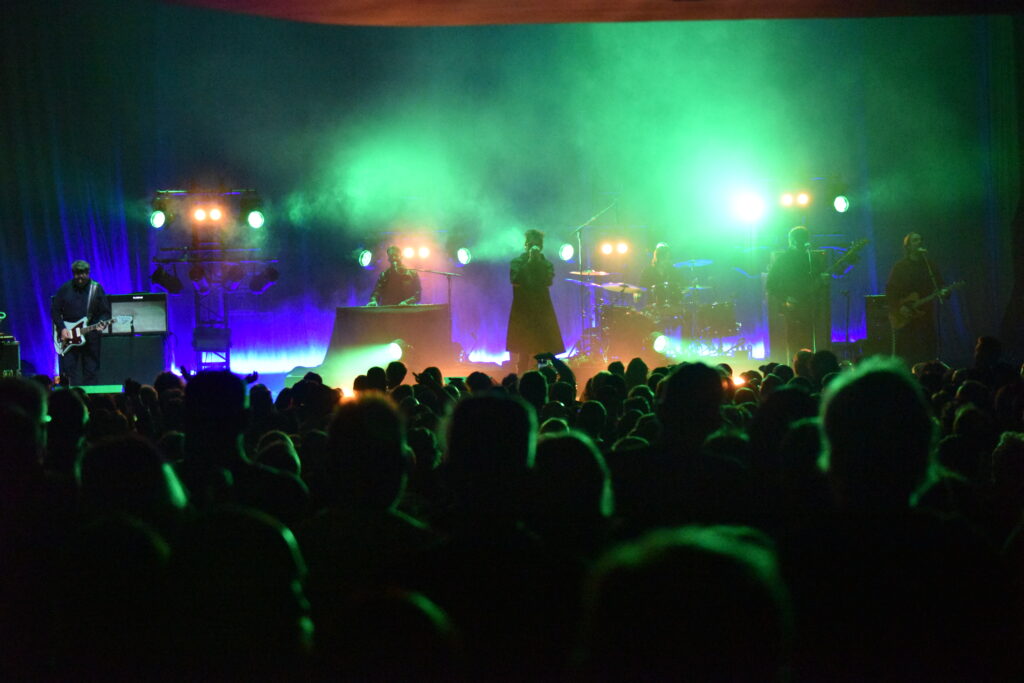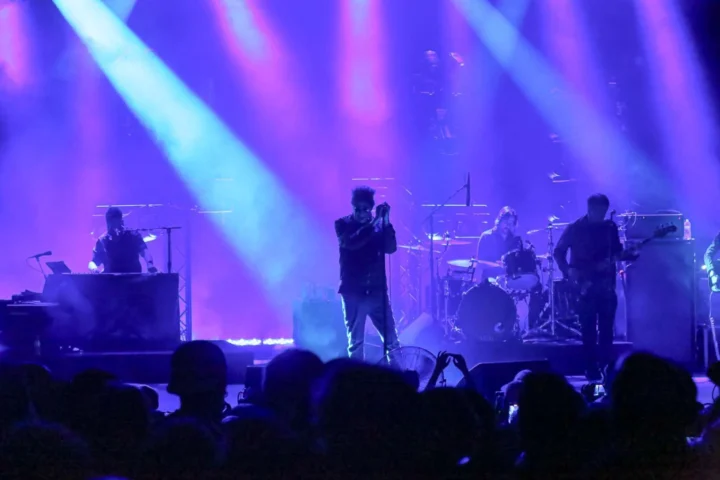
There’s something oddly comforting about walking into a room lit like the inside of a cigarette burn. That was the vibe Friday night at SF Masonic Auditorium, where Echo & the Bunnymen shuffled onstage beneath a wash of dim blues and shadow-black lighting that felt less “concert production” and more séance in a downtown cathedral. Moody as hell. Half the crowd looked like they’d wandered in from a lost 1987 college radio broadcast.
And then there’s Ian McCulloch.
Still draped in a long trench coat. Still hiding behind those dark glasses like some noir antihero who accidentally fronted one of post-punk’s most enduring bands. The Jim Morrison comparison? Yeah, it’s unavoidable. Always has been. But seeing McCulloch live now, older and somehow even more spectral, the thing that struck me wasn’t imitation, it was how fully he’s metabolized those influences into something stranger and distinctly his own. Morrison was swagger. McCulloch is weather. Different animal entirely.
More to the point: the guy sounded fantastic.
No kidding. His voice carried that smoky, bruised quality that aging singers either lose completely or sharpen into something richer. He leaned into it. During “Going Up,” the opener, there was already this sense the band wasn’t coasting on nostalgia. “All That Jazz” and “Heads Will Roll” followed with that same muscular gloom the Bunnymen practically patented decades ago, and suddenly the room felt much smaller than it was.
I’ve always thought Echo & the Bunnymen sounded like The Doors if they’d grown up in rain-soaked Liverpool instead of sunburned Los Angeles. Same hypnotic pulse, same dramatic tension, except dipped in goth aesthetics and cigarette ash. Friday night, they basically confirmed the theory themselves. Midway through a sprawling “Villiers Terrace,” the band slid straight into “Roadhouse Blues,” grinning at the comparison instead of running from it. Honestly? It ruled. A little messy, a little indulgent. Exactly what you want from a legacy act that still has blood in its veins.
And they weren’t done pulling ghosts into the room.
“Nothing Lasts Forever” drifted beautifully into Lou Reed’s “Walk on the Wild Side,” a move that could’ve come off corny in lesser hands but instead landed like a late-night toast to the weird kids who made rock music dangerous once upon a time. McCulloch, intentionally or not, reminded everyone not to forget the greats. Reed. Bowie. Morrison. The lineage was all over the set.
Though — and this became part of the charm, weirdly — nobody had the faintest clue what McCulloch was saying between songs.
Seriously. At one point the guy sitting next to me leaned over and deadpanned, “Are there subtitles?” I nearly spit out my beer. McCulloch mumbled, rambled, muttered toward the mic in this thick stream of poetic fog that dissolved into reverb before reaching the cheap seats. Could’ve been profound. Could’ve been directions to Trader Joe’s. Impossible to know.
Didn’t matter much.
Because once “Seven Seas,” “Rescue,” and the towering “The Cutter” kicked in, the crowd locked right back into that familiar Bunnymen spell. The chiming guitars, the cavernous drums, the feeling that every song arrives trailing moonlight behind it. “Bring On the Dancing Horses” got one of the night’s biggest reactions, though “The Killing Moon” was the real gravitational center of the evening. You could feel the room collectively inhale during those opening notes. Some songs age. That one just hangs there outside of time, stubborn and immaculate.
The encores pushed things into full emotional-comedown territory. “Lips Like Sugar” turned the room euphoric for a few minutes, strangers singing at each other like they’d known one another since the Reagan administration, and then came “Ocean Rain,” which landed soft and haunting and almost absurdly beautiful in the dark.
Funny thing is, the show wasn’t perfect. Far from it. The lighting occasionally swallowed the stage whole. McCulloch was unintelligible half the time. A couple transitions dragged. But perfection would’ve felt wrong somehow. Echo & the Bunnymen have always thrived in the shadows: beautiful, romantic, slightly frayed around the edges.
Like old vinyl crackle. Like rain on Market Street at midnight. Like memories you can’t quite trust anymore, but keep revisiting anyway.